Before any code
Ownership and system of record, risk classification, and a complete product definition — Phases 0–2.
Visual Edition 2.1 · Current through Aug 4, 2026
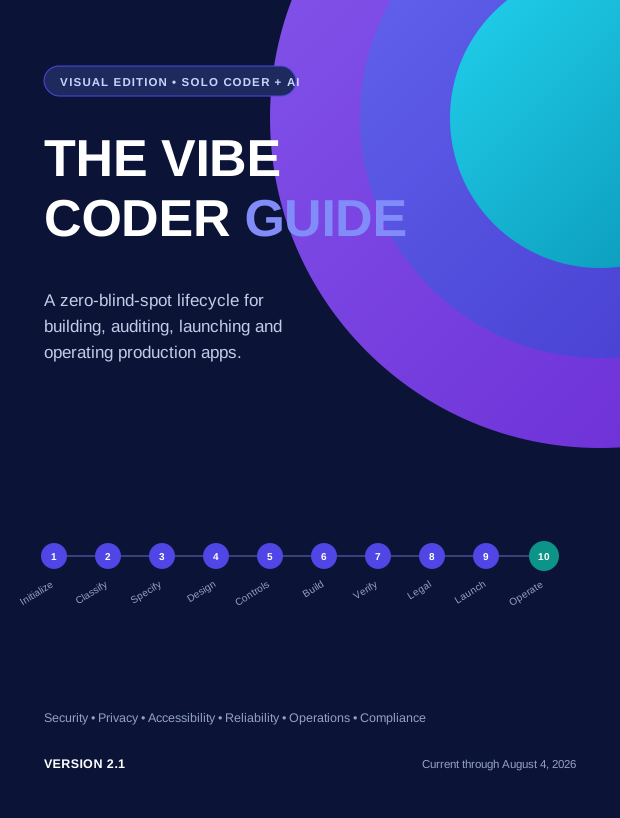
A generated app can look finished while only the happy path exists. The Vibe Coder Guide is a 93-page, gate-by-gate system that takes an AI-assisted build from prompt to production — with the security, privacy, accessibility, reliability, and legal work that demos quietly skip.
Build smarter. Ship faster. Stop guessing.
The gap
The demo passes. Then the first real user, the first duplicate request, the first screen reader, the first refund, the first outage. Here is the surface area a vibe-coded app usually leaves undefended.
Authorization that exists only in the UI
Tenant boundaries nobody ever tested
Secrets sitting in client code or git history
Privacy promises the code doesn't keep
Flows no keyboard or screen reader can finish
Retries and timeouts that double-charge users
Backups that were never actually restored
Migrations with no rehearsal and no rollback
Alerts that reach nobody at 3am
Store disclosures that contradict the app
Admin tools that can impersonate without audit
AI features that can act with the user's authority
The system
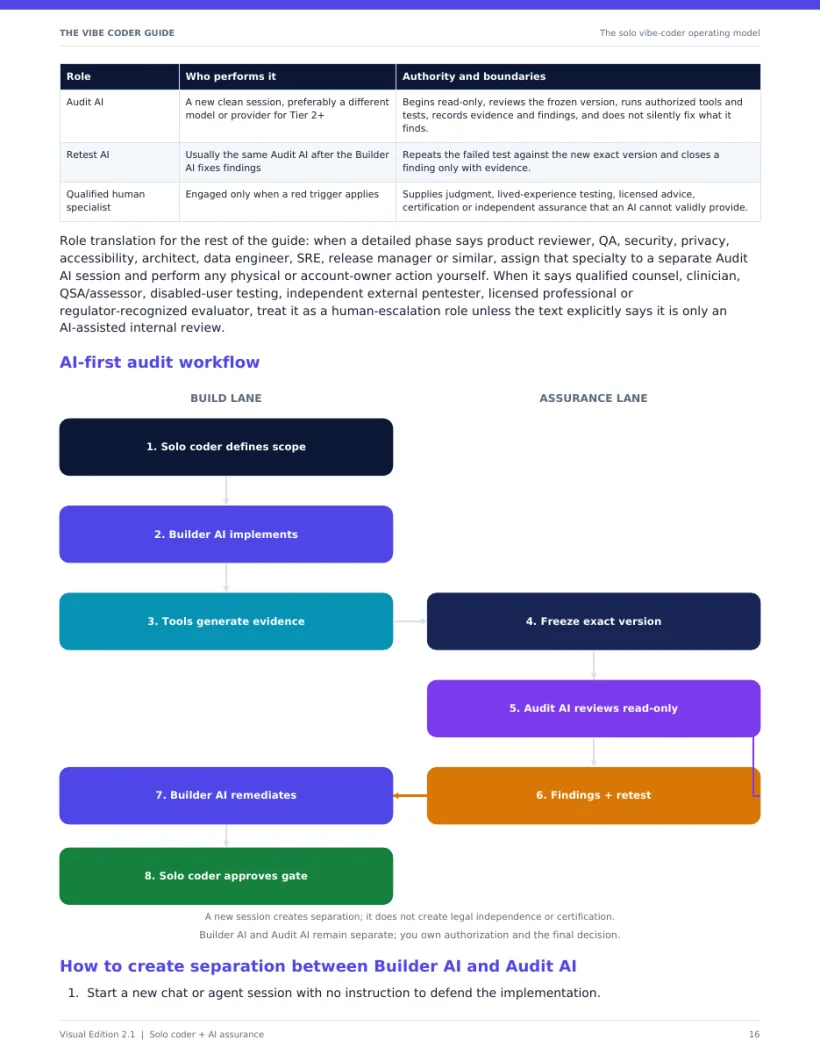
You work one stage at a time. Your Builder AI creates. A separate, clean-session Audit AI reviews the frozen version read-only and reports evidence. You fix, retest, and only then pass the gate. Nothing advances because code exists — it advances because proof exists.
Builder AI creates. Audit AI starts clean, reviews read-only, and reports evidence. No AI silently approves its own work.
Every audit names the exact commit, build, configuration, model, prompt and environment it examined.
Scanners, tests, staging, physical devices and manual checks — not an AI's confident summary.
Defined moments where an AI review must stop and a qualified human takes over: law, certification, high-impact risk, severe harm.
What's inside
Every phase ends in an exit gate with required artifacts. Every audit says when it runs, where it runs, who performs it, and what evidence it must produce.
Ownership and system of record, risk classification, and a complete product definition — Phases 0–2.
Data inventory and governance, architecture and failure boundaries, threat modelling, and accessible, honest UX — Phases 3–6.
Supply chain, identity and authorization, application security controls, data integrity and recovery, resilient APIs and jobs, safe admin and moderation — Phases 7–12.
Activated by what your app actually does: payments and subscriptions, AI and autonomous agents, children and education, health, credit and housing decisions, location and biometrics, enterprise multi-tenancy, offline and IoT, analytics and SEO, internationalization.
The complete test system, reliability, performance, observability and cost, plus incident, breach and business-continuity response — Phases 13–15.
Entity and IP ownership, terms, privacy notices, DPAs, licences, billing, taxes, refunds, marketing substantiation, and app-store readiness — Phases 16–17.
The launch gate itself — staged rollout, abort thresholds, rollback owner — then operating, patching, retesting and retiring safely — Phases 18–19.
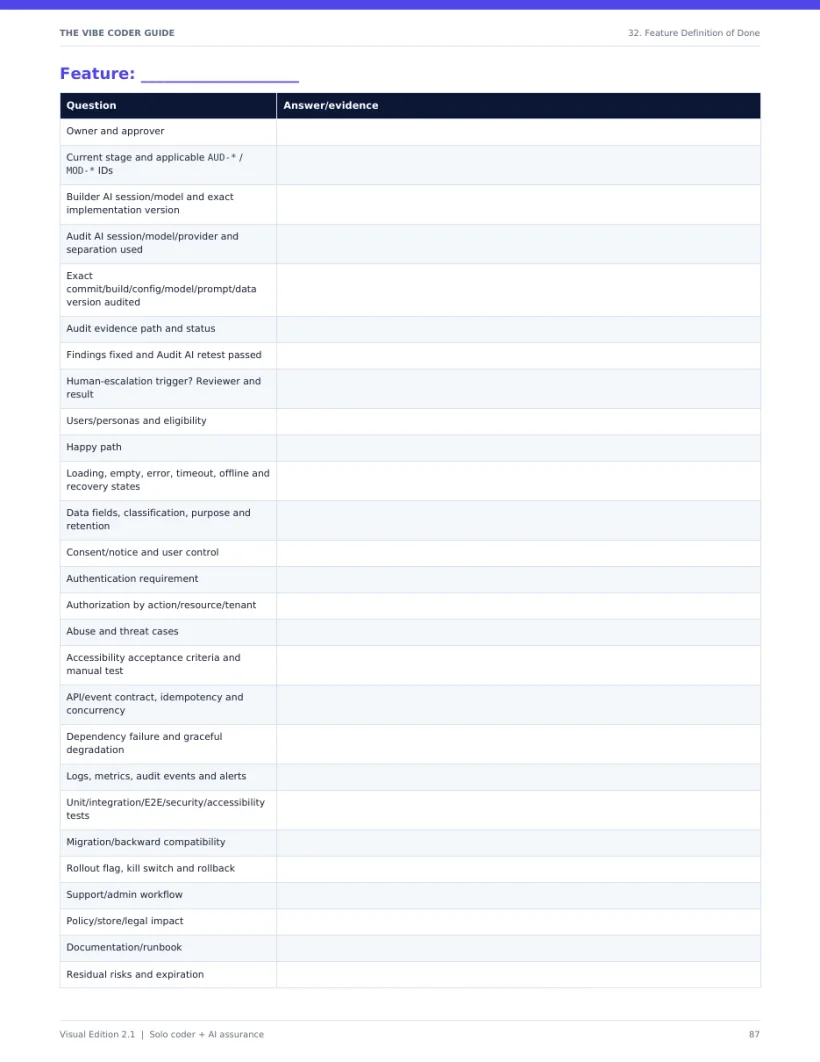
Feature Definition of Done, ten questions to ask before accepting any AI-generated feature, stop-ship red flags, a paste-ready build instruction for a coding agent, and AI-first vs human-escalation checkpoints.
Primary sources to check at project start and again before launch — security, accessibility, privacy, children and health, payments, stores and AI.
Proportional, not paranoid
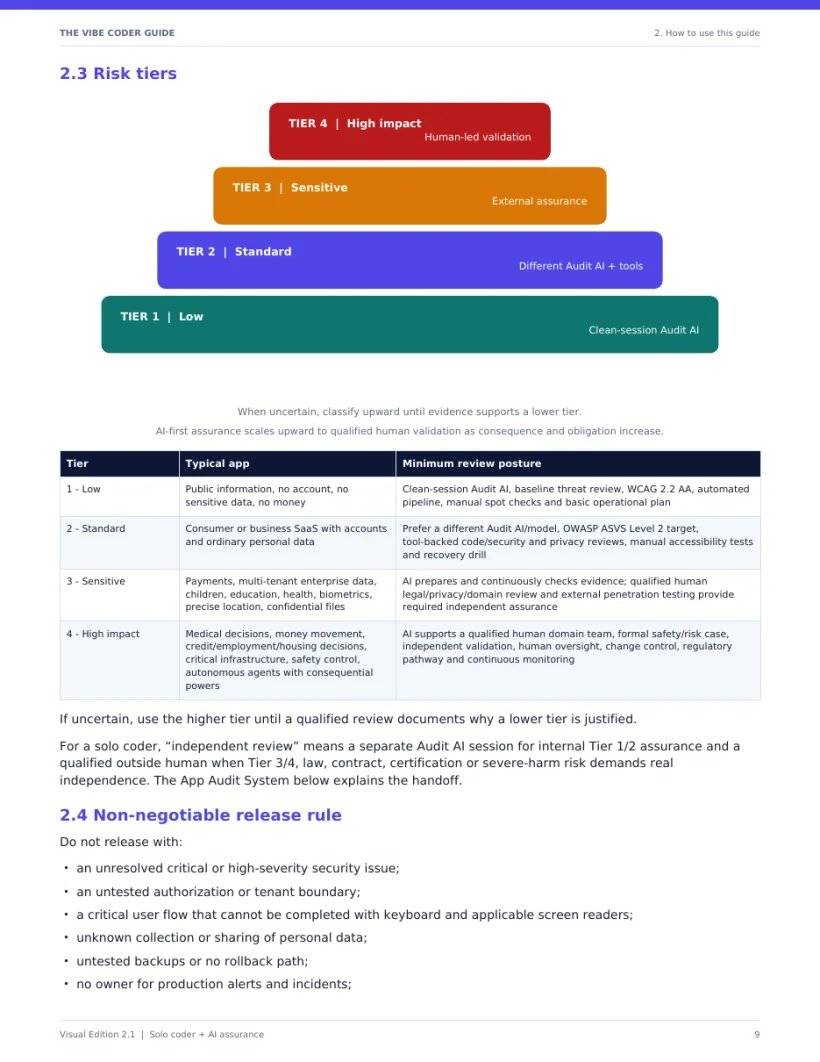
A public marketing site and a consumer lending app do not deserve the same process. Stage 2 classifies the app, and the tier sets the minimum review posture for everything downstream. When you're uncertain, you classify upward until evidence justifies a lower tier.
The same logic activates conditional modules — payments, AI agents, children, health, biometrics — so you only carry the obligations your app actually triggers.
Look inside
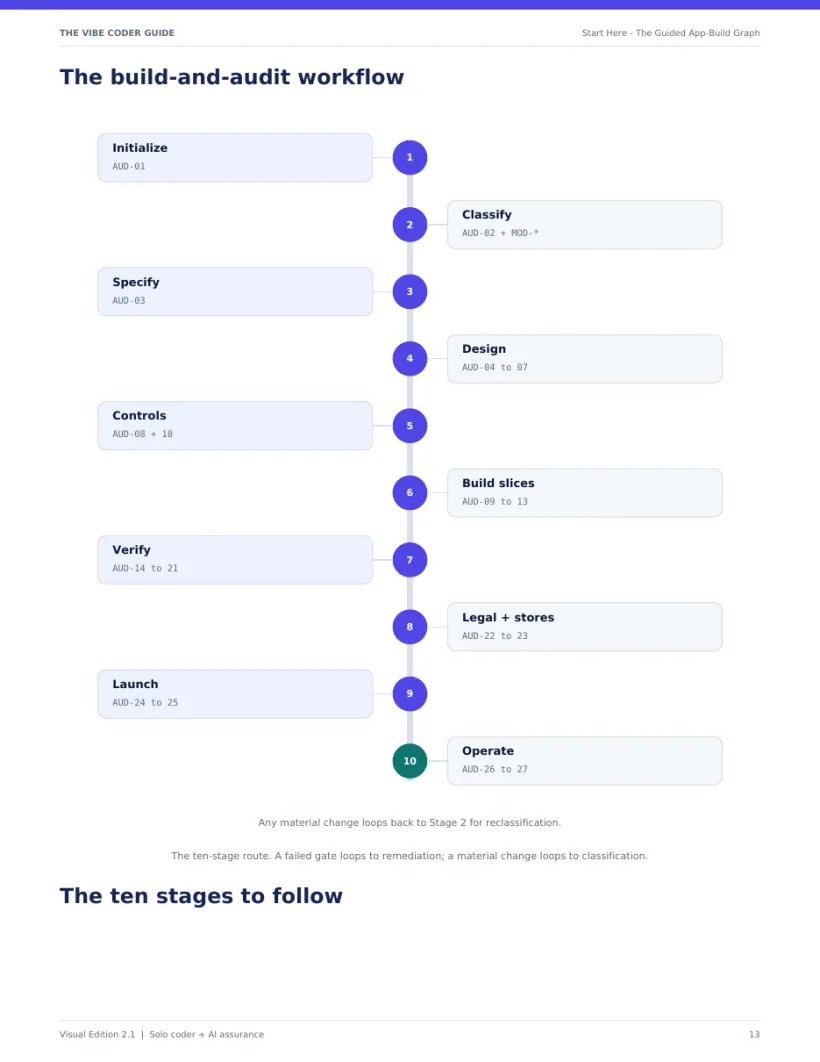
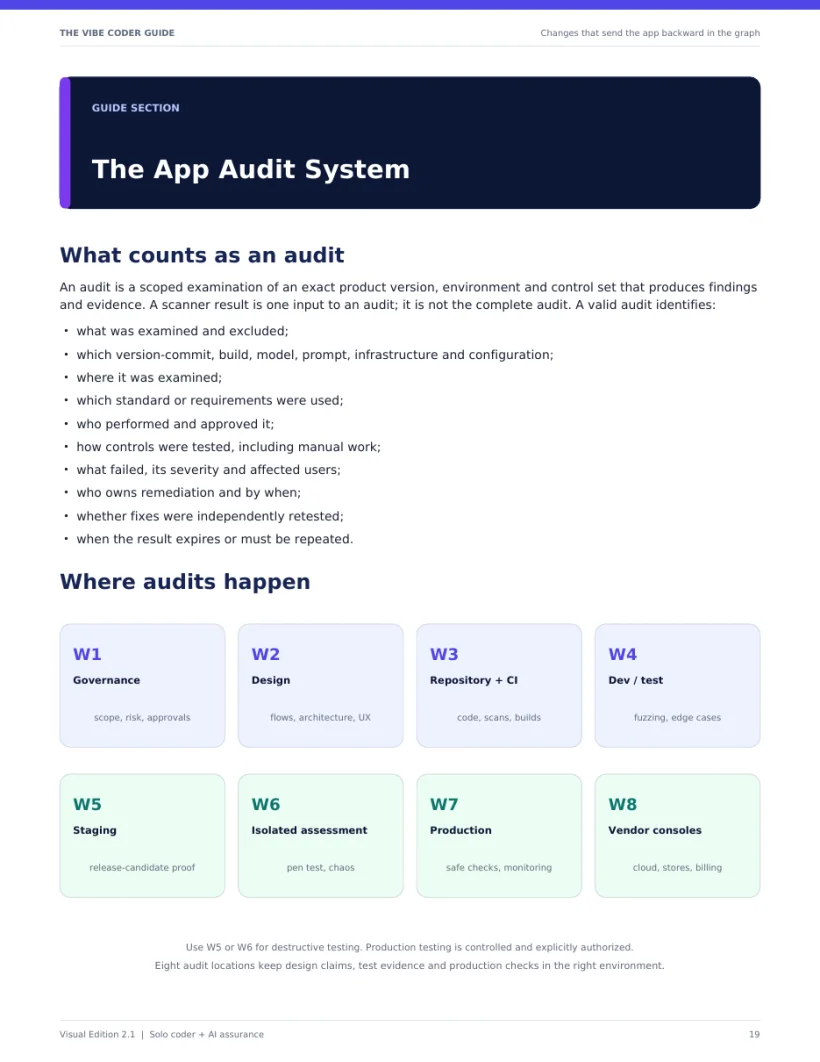
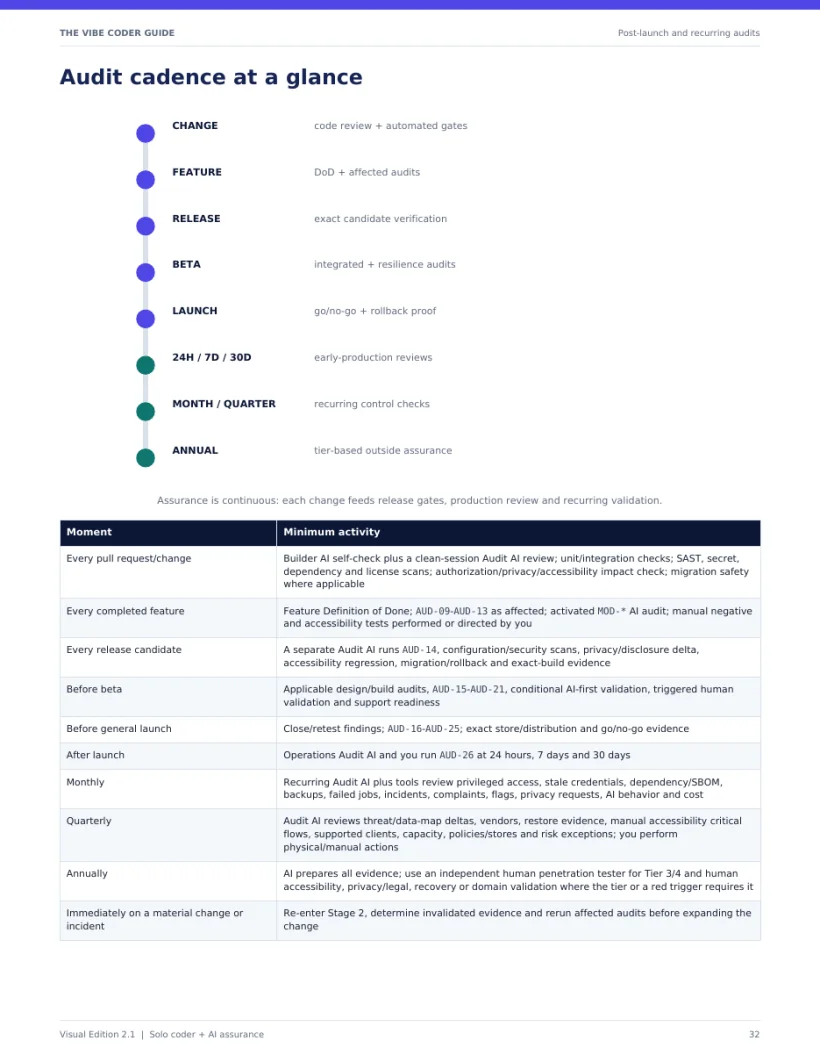
It's a visual edition: diagrams, decision tables and fill-in templates you can work from directly — not a wall of prose.
Grounded in current baselines
Default engineering targets are OWASP ASVS 5.0, NIST SSDF 1.1 and WCAG 2.2 Level AA — plus the platform and sector sources that apply to what you're building. Part IX lists every primary source so you can re-check them at project start and again before launch.
The Vibe Coder Guide — Visual Edition 2.1
One unreviewed authorization bug, one failed store review, one untested restore costs more than this in a single afternoon. Buy once, use it on every app you build.
$49.95 USD · one-time
Instant download after checkout, plus a copy by email.
Secure payment by Stripe. We never see or store your card details.
All sales are final — it's a digital file, delivered instantly. So we've put six real pages on this page: read them before you buy, or ask us anything first.
By purchasing you agree to the Terms of Sale and the Privacy Notice.
Questions
A 93-page PDF — The Vibe Coder Guide, Visual Edition 2.1. It contains the ten-stage build-and-audit graph, 20 numbered phases, 27 audit definitions with when/where/who/evidence, eight audit environments, four risk tiers, conditional modules for payments, AI, children, health, finance, location and enterprise, plus reusable templates including a Feature Definition of Done and a paste-ready build instruction for a coding agent. You download it immediately after checkout and the link is also emailed to you.
No. The guide is written for a solo builder working with AI coding tools. It tells you what to require, what evidence to demand, and when to stop and bring in a qualified human. You don't need to write the code yourself — you need to be able to read a gate and refuse to pass it.
No. It's stack-agnostic. The requirements, audits and gates apply whether your AI wrote React, Swift, Python or anything else, and whether you ship to the web, the App Store or Google Play.
Default engineering targets are OWASP ASVS 5.0, NIST SSDF 1.1 and WCAG 2.2 Level AA, plus the platform and sector sources listed in the final chapter — OWASP MASVS, NIST SP 800-63B-4, CISA Secure by Design, NTIA SBOM minimum elements, GDPR and CCPA, COPPA, FERPA, HIPAA, PCI DSS 4.0.1, the NIST AI Risk Management Framework and the EU AI Act.
No. It's an engineering and product-governance guide. It's explicit that an AI-assisted internal audit is not a third-party certification or a licensed opinion, and it routes you to qualified humans — counsel, clinicians, accessibility specialists, external penetration testers — at defined escalation triggers.
Checkout is handled by Stripe. The moment payment succeeds you get a secure download link on screen and by email, and you keep the file permanently.
All sales are final. It's a digital file that transfers to you instantly and can't be returned, so we don't offer refunds, returns or cancellations — which is exactly why six real pages, the full contents breakdown, and a blunt "who this isn't for" section are all on this page before you spend anything. Still unsure? Ask us first and we'll tell you honestly if it's not a fit.
Separately: if your link expires, you lose the file, it won't open, or you're charged twice — that's not a refund, that's support, and we fix it free. See the refund policy.
Yes — one purchase covers you as an individual builder, including on apps you build for clients. What you can't do is redistribute, resell or republish the file itself, or share your download link. Team and organisation licences are available: email support@vibecoderguide.net. See the licence for details.
It's built to WCAG 2.2 Level AA — full keyboard operation, visible focus, tested contrast, semantic landmarks, reduced-motion support and a light theme. If anything blocks you, tell us and we'll fix it: read the accessibility statement.
The durable advantage isn't generating more code. It's making every requirement, boundary, failure, control and proof explicit — then refusing to launch until the important ones are real.
93-page PDF · instant download · secure Stripe checkout · all sales final